How Much Does a PIM Cost in 2026? Key Factors and Insights
Last Updated: 3 Feb 2026
12 Mins Read
A PIM platform plays a huge role in redefining how eCommerce businesses manage their product data.
It brings a revolutionary change in reducing the dependencies on manual work, bringing down the
excessive use of spreadsheets and legacy systems.
An eCommerce business would want to implement a PIM for various reasons and to accomplish different
outcomes. The objectives could vary based on the business priorities, size, and industry.
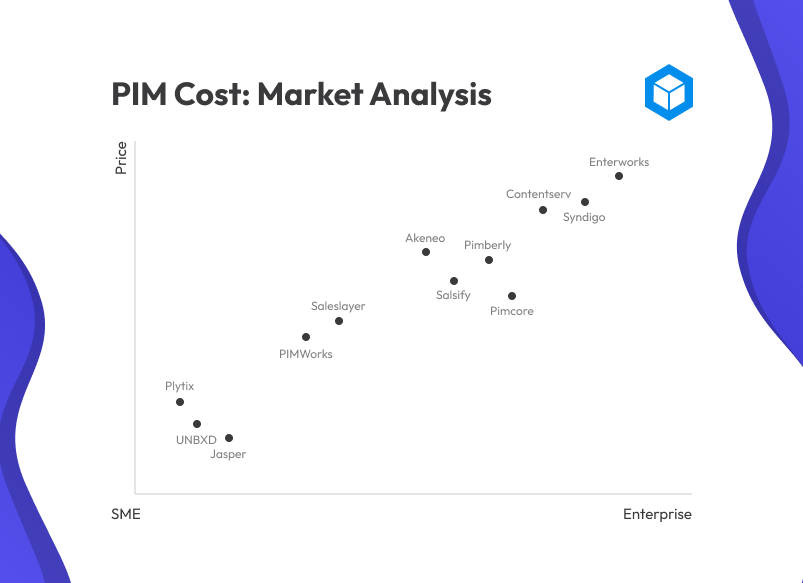
So, does this impact the cost of PIM? The short answer is yes.
You can purchase a PIM software starting from a free 30-day trial, for $699 per month to
$25,000
per year. The cost of product information management software is mainly influenced by the number of
SKUs and your marketplace presence.
Are you curious about the potential factors impacting the PIM price, the various costs involved in
implementing PIM, and the hidden costs associated with PIM?
Well, you’ll get to know all of these before you leave this page!
Before looking at the pricing of a PIM, you need to ask yourselves these questions and look
at the business fit:
✅Which customer channels do most of your business come from?
✅Do your key channels accept data in standard templates or require complex templates, processes, or
guidelines?
✅Are you looking for platforms that give better integrations without manual processes? These
platforms can range from $1,000 to $2,000 per month
✅How many integrations does your business need?
✅Do your key channels accept data in standard templates?
✅Are you specifically looking for platforms that give flexible tools to manipulate and export data
. These platforms can range from $500 to $800 per month
✅Are you cautious when you choose the platforms to see if they can help you expand and grow in the
future? This is because a PIM implementation involves key business change, time, and effort.
Choosing a provider who is too cheap or too expensive will hurt your business growth
✅Are you a larger enterprise where there may be a need for some customization and are you looking
for platforms that are flexible to accommodate these at a nominal cost?
How
much does a PIM cost?
As we discussed, PIM cost might vary depending on several factors. And generally, there are two
types of costs that you need to deal with: One-time costs and Ongoing costs. Let us help you get
a clear idea of what they are.
One-Time Costs
Yes, you are right. These are the costs that you will have to face only once, typically during
the initial phase. You can think of them as the foundation for your Journey ahead. This could
vary depending on the size and requirements of each business. The more complex the need is, the
higher the cost will be! Let us break down and explore the one-time costs involved.
Conception Cost: The first and foremost step for anything we do is
Brainstorming! This is where you need to figure out what exactly you want to achieve with your
PIM solution. Either you can do your own research or hire a professional consultant to analyze
the needs and gather requirements. The conception cost will cover the cost incurred through
either of the options.
Evaluation cost: Once you get a clear understanding of your needs, you will
think of choosing the best PIM for your business. This means you will be exploring the various
PIM software available in the market. Evaluation costs include the time and resources that you
spend on exploring the various options and attending demos and presentations.
Set-up Cost: Now that you have selected the right PIM for your business, the
next step is to set it up for use. You might want to make the system compatible with your
existing tools and databases to ensure a seamless performance. Again, the setup cost could vary
depending on the complexity involved.
License Acquisition cost: Just like any other software, you need to buy a
License to use the PIM software. There are many types of licenses available in the market, you
need to choose the one that best fits you carefully. The cost will either be a one-time payment
or recurring depending upon the type of license and the software provider. Choose wisely!
Customization and Implementation Cost: Every business is unique and will have
its own needs and requirements. Yes, you can tailor your PIM to fit your specific needs. You
might want to migrate your existing data, Integrate your PIM with other systems that you are
currently using, program workflows, and add any new features. Customization and Implementation
costs will cover all of these.
Ongoing Costs
Now that you have set up your PIM and started using it, it doesn’t end up there. You’ll need to
budget your expenses to keep things running smoothly!
License Renewal Cost: As we discussed earlier, depending on the type of license
you acquire, the license cost could be either one-time or ongoing. If you buy a rental license
or a subscription-based one, you will have to pay the money at recurring intervals to continue
using the PIM software.
Maintenance and Support Cost: Let it be any product, definitely some kind of
maintenance is necessary! Similarly, PIM software will also need regular maintenance to ensure a
smooth operation. This could be any bug fixes or software upgrades. PIM providers offer various
support options like Email support, Call support, or even a dedicated account manager. Hence,
the expense could vary based on your requirements.
Hosting Cost: You can host the PIM either on your own servers, rented servers,
or even on a cloud platform. The cost involved will vary based on the storage space required,
bandwidth usage, and the level of support you need.
Run Cost: Yes, this is the cost incurred for the seamless running of your PIM.
This might include the support for integration or regular monitoring of the third-party channels
for updates and implementation. This will again vary depending on the number of connections.
Hope you have gained a better understanding of the various costs involved. This will greatly
help you in your decision-making, as now you can better analyze the options!
Types of PIMs
and Their Pricing Models
These are the three most common types of PIMs available in the market. Understanding how they
work and their pricing models could help you choose the right PIM for your business.
Open Source
Open Source PIM is free to use and is highly customizable. You can modify the source code to
meet your specific business needs.
Pricing:
The software itself is free (some vendors may charge a one-time licensing fee), but there could
be additional costs that’ll incur for hosting, customization, implementation, and maintenance.
Ideal for:
Companies that need extensive customization and have in-house tech expertise.
SaaS
SaaS PIM is a cloud-based PIM hosted by the vendor and accessed online via browsers. It is
easily scalable with minimal IT needs.
Pricing:
Typically, subscription-based (monthly or yearly, or quarterly), depending on the vendor.
Often provided as tiered plans, with prices varying based on the set of features offered. Some
vendors also provide custom pricing, taking into account your specific needs and requirements.
Ideal for:
Businesses that need quick deployment with lower upfront costs.
On-Premise
An On-premise PIM is installed on your own company’s servers, which gives you full control,
security, and customizations.
Pricing:
Usually, it comes with a one-time licensing fee.
While the upfront investment is high, the long-term software cost would be less. On the other
side, it incurs additional costs for maintenance, internal IT support, software upgrades, and
potential hardware costs as it is hosted on your server.
Ideal for:
Large enterprises with strict compliance needs.
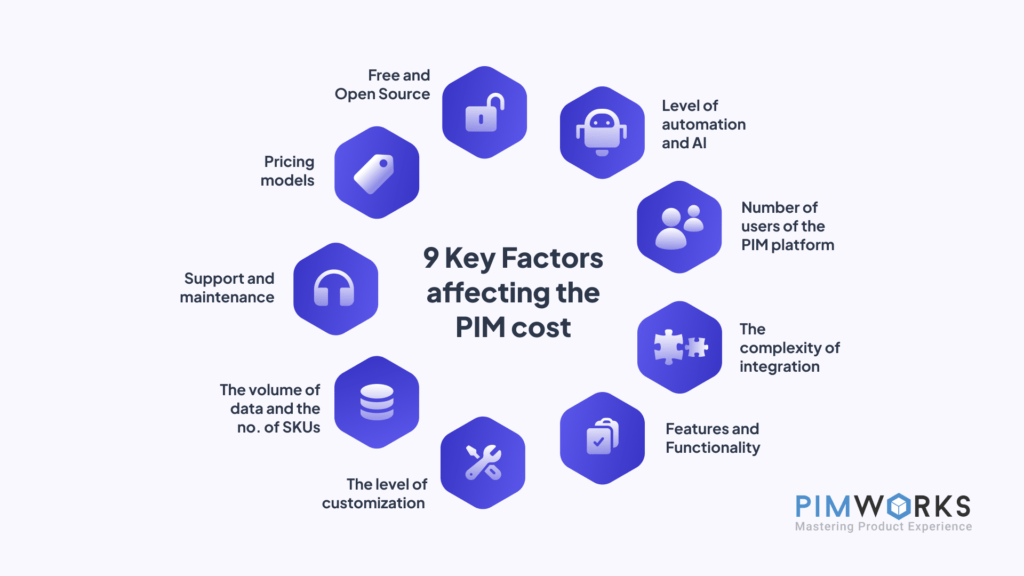
9 Key Factors Affecting The PIM
Cost
Here are some aspects a business looking to invest in a PIM consider:
1. Number of users of the PIM platform
Some PIM systems charge based on the number of users of the PIM platform. So, before investing
in a PIM, understand who would be the end-users of the PIM platform.
It is always a good practice to map the users of the PIM (role) with the objective. This will
give you a clear picture of the usage cost.
2. The complexity of integration
A PIM system, when integrated with your existing platforms and marketplaces can do wonders for
your business. For instance, if you are selling on Amazon and Walmart online stores, a PIM can
help you natively integrate with these platforms.
This integration can benefit you by having a two-way synchronization of all your data. When it
comes to the cost factor, the complexity of integrating the PIM system with your existing
software and the number of channels can influence the pricing.
If you have multiple software platforms that need to be connected, this can add to the expense.
Some of the PIM platforms charge based on the number of exports. This is because these platforms
don’t have native integrations with marketplaces and channels.
Their data syndication is typically cumbersome and involves:
The data has to be prepared manually to ensure that it complies with the channel or
marketplace to which it is syndicated to. On average, preparing one data template for retail
takes about 3-4 days and the effort costs around $500
The mapping of data happens manually. The template is downloaded from the channel and
uploaded back to the PIM platform (you cannot copy + paste column to column)
Once the mapping is done, the template has to be uploaded back to the channel and this is
generally not successful in the first go. You get errors, and run into a loop of endless
re-work, creating and fixing the data errors losing a lot of time and money
How does PIMworks stand out?
PIMworks’ cost is based on the number of channels you publish your content on and not based on
the number of exports. The advantage here is, that unlike a few other players in the market,
PIMworks has pre-built templates for all the key channels and marketplaces that make automating
and syndicating the product catalog content a breeze.
You don’t have to manually get the templates, it is configured already and ready to go. Your
data also goes through a health check before syndication that helps you monitor and track the
changes needed.
3. Features and Functionality
This is the most crucial factor that determines the cost of a PIM solution. There are platforms
in the market that offer a vast range of features and functionality
that can significantly affect the cost. More advanced and comprehensive PIM solutions tend to be
more expensive.
If you have multiple stakeholders in the supply chain, like vendors, supplies, retailers, and
others involved in contributing to your product information, managing the workflows could get a
bit complex. In such scenarios, you need a PIM platform that can help you create seamless
workflows and give your stakeholders granular access controls.
Another advanced feature is the integrations that we discussed. If you are looking at robust
integrations, that could inflate the cost to a certain extent.
💡Do your syndication channels expect data in a certain way and constantly change the
formats?
A lot of eCommerce businesses work with channels that demand data in a specific format. Not just
that, these formats are subjected to continuous changes and you have to be assertive and
proactive to keep up with these changes.
A platform like PIMworks can help you with data preparation and ensure that you stay compliant
with the periodic changes.
4. The level of customization
Every eCommerce business and its needs are different. For instance, an eCommerce business would
want specific fields in their product catalog to meet the unique requirements of their business
or specific taxonomy classification.
If you need extensive customization to tailor the PIM system to your unique business
requirements, this can increase the cost. The more you customize the PIM platform to meet your
unique needs, the costlier it could get.
5. The volume of data and the no. of SKUs
An eCommerce giant with huge volumes of product data needs a PIM platform that is scalable. The
amount of data (SKUs, product information, media files, etc.) that the PIM system will manage
can impact the cost.
Online websites with high data volumes often require more powerful infrastructure that could
potentially impact pricing.
6. Support and maintenance
A PIM platform needs ongoing support and maintenance. There are a variety of modules in a PIM
that need extensive training, updates, and more.
Some PIM systems offer additional modules or extensions for functionalities like data quality,
digital asset management, or workflow automation. Purchasing these modules may increase the
overall cost.
7. Pricing models
Usage-based pricing: Some PIM systems may charge based on the amount of
data you store or the number of API calls or data transactions.
Custom pricing: For larger enterprises or unique requirements, custom
pricing may be negotiated with the vendor based on your specific needs.
Each PIM provider has their own approach and has different PIM Pricing Models. Some may charge
based on the number of users, SKUs, or integrations, while others may have tiered pricing
plans.
8. Free and Open Source
Some PIM systems are open-source or have free versions with limited features. However, these may
require more in-house development and support.
9. Level of automation and AI
A PIM platform can be modern and advanced with AI features for data enrichment. While a lot
of PIM players don’t offer advanced features to create catalogs at speed and with accuracy, the
ones that do might offer this feature at a price. How do PIM platforms help you leverage AI:
Let AI write product descriptions
Use AI to complete the missing information in your catalogs
AI-driven language translation tools can help in translating product information into
multiple languages
AI can monitor competitor activities and pricing strategies
AI can be used to automatically identify and correct data inconsistencies
Hidden Costs of PIM
While investing in a PIM, there could be some additional costs businesses may not have initially
thought of that could increase PIM expenses.
Here are a few aspects that could be hidden or unknown at the time of investing in the software:
Professional Services (consulting, training, customizations)
Support Services
Adding new channels
Data quality management
Maintenance and scalability costs
Analyzing and mitigating these hidden costs will help you make informed decisions. To avoid
these hidden costs, clearly define the needs and identify the features required for your
organization. Make sure, you clearly discuss the pricing details with your PIM provider to
ensure transparency, avoiding unpleasant surprises.
Tips to
Calculate Total Cost of Ownership (TCO)
Calculating the Total Cost of Ownership helps you get a clear picture of both the initial and
ongoing costs associated with PIM. It helps in making a smarter investment.
TCO is usually calculated for a long-term (often three to five years).
Key components:
License or Subscription Fees: One-time software licensing fee or Recurring
subscription
Implementation Costs: Data migration, integrations with your existing tech
stack or eCommerce platforms, customization and initial setup.
Maintenance & Support: Hosting, Upgrades, security, troubleshooting, and IT
support.
Training Costs: Onboarding your team.
Indirect Costs: Time spent on evaluation and deployment.
Understanding the ROI
Now, that you’ve got clear understanding of the costs involved, it’s time to look at ROI. This
helps you justify the investment by getting clear on the impact PIM can have on your business.
You know that PIM can help save time on hours of manual work, reduce errors, speed up product
launches across multiple channels, and improve overall efficiency.
But how do you actually quantify the benefits? And weigh them against the costs?
So, all clear? Ready to compare start comparing PIMs?
Here are few important questions that you need to ask the vendors to understand the pricing
completely and avoid any surprises later.
What’s included in the license or subscription fee?
Do you provide a free trial period?
Are there extra charges for implementation, onboarding or training?
Will adding extra features or integrations cost more?
How does the price change if we add more users, products, or channels?
Are there limits on storage, number of products, or data usage that could incur extra fees?
Is support, maintenance, and updates included in the price, or is that extra?
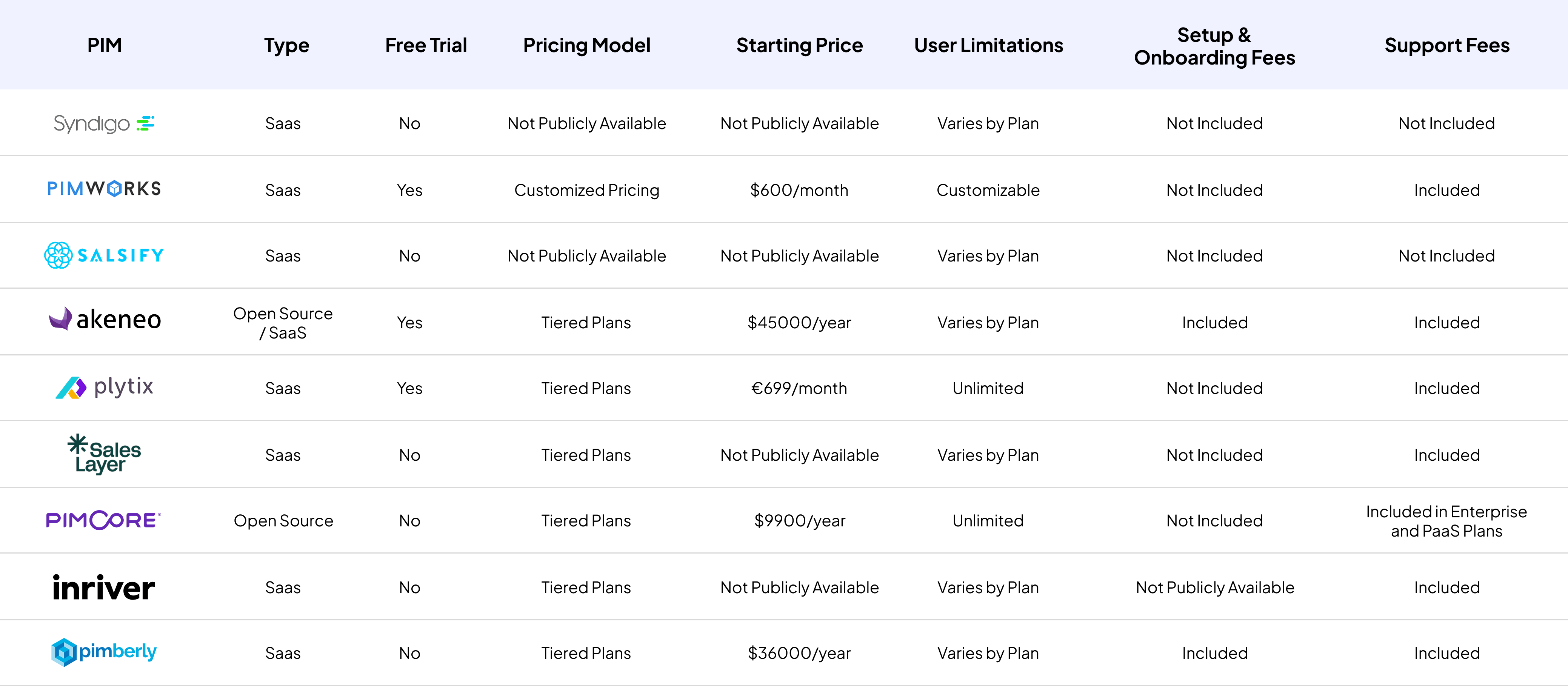
PIM pricing comparison table
Final
thoughts
Understanding the cost of implementing a PIM solution and analyzing its potential value is a
huge step toward effective product data management. As we discussed, PIM costs can vary
depending on multiple factors like the choice of software provider, Number of SKUs and users,
and the complexity and scale of your business needs.
Investment in a PIM system is a strategic decision that can bring significant
benefits over the long term. The series of costs involved in implementing a PIM might appear to
be a maze of expenses. But with careful consideration and planning, you can reap your fruit very
soon.
To make an informed decision, consider your specific needs, budget, and long-term scalability
needs.
Want to know how much a PIM would actually cost for your business?
PIM
stands for product information management, a software that helps eCommerce businesses
centrally store, manage, and distribute product data across multiple channels.
What are the benefits of PIM?
PIM system saves time, reduces errors, accelerates product
launches, and ensures consistent product information across all sales channels.
How much does a PIM cost?
PIM pricing starts at $600 per month. Major factors influencing
the cost include the number of SKUs, integrations needed, level of customization, and data
complexity.
How to ensure transparency in PIM pricing when selecting
a PIM provider?
Clearly communicate your needs and requirements with the PIM
provider to uncover all the possible expenses that may arise throughout the Journey. Also,
make sure to clarify the pricing and contract terms before making a decision.