Best Product Information Management Software in 2026
Last Updated: 26 Feb 2026
12 Mins Read
Searching for the Best PIM Software?
Well, you’re definitely not short on options! There are tons of choices out in the market, each claiming to be the best. But the truth is—there’s no universal one-size-fits-all PIM solution.
Every PIM Tool is built from a different perspective and focus. Some are tailored for large businesses with complex catalogs, while some are for growing brands selling across various marketplaces, and it goes on.
So, instead of looking for the “best”, you need to analyze and figure out the “right” PIM for you. The one that’ll align with your specific business needs, ease your operations, eliminate data chaos, and scale as you grow.
Let’s be honest: PIM isn’t just another tool that you can buy, test, and switch often. It’s going to be the backbone of how you manage and distribute your product information. When it’s stuck, everything else will also get stuck. And the switching cost? That’s way more higher than you think. That’s why it’s smart to do your research and choose the right PIM at the start itself.
Figuring that out might take a little longer. But trust me, it’s worth it!
To help you along the way, we’ve listed the pros, cons, features, and use cases of the ten top PIM solutions available in the market. Before jumping into that, let’s step back for a moment to get clear on a few things: What exactly is PIM? Why does it matter? And what features should you really care about?
Ready?
What exactly is PIM?
As you already know, PIM stands for Product Information Management. PIM software helps you centralize all your product info—everything from titles, descriptions, prices, images, specs, SKU IDs, videos, and more.
In short, it acts as a Single source of truth for your product data, helping you syndicate accurate and consistent content across multiple channels in one go.
For a deeper understanding, check out our detailed guide on What is PIM.
What are the Benefits of PIM?
Implementing a PIM system can bring in numerous benefits. Here are a few notable ones:
Centralizes your product data, so you don’t have to juggle between spreadsheets, ERP, CMS, and what else?
Maintains consistency across your sales channels, eliminating errors and confusion.
Speeds up time to market, enabling easier updates across all channels.
Bring your teams together, making collaboration and decision making much smoother.
Enhances customer experience by providing accurate and reliable product information.
Key Features to look for in a PIM
Even though we say there isn’t a universal best PIM software available, there are certain features that can’t be neglected, irrespective of your business.
Bulk Import & Editing
Easily upload and update large volumes of product data in just a few clicks, saving time and avoiding manual errors.
Digital Asset Management
Organize and manage all your product related media files, including images, videos, PDFs, and more.
Data Validation & Governance
Ensure product data is complete, accurate, and compliant with built-in or customizable rules and checks. Health check against specific marketplace guidelines (like Amazon, Walmart, and more) prevents your catalog from getting rejected.
Integration Support
Connect seamlessly with your existing systems, such as ERP, CMS, eCommerce platforms, and more, for smooth data flow. Native integrations are a plus.
User Roles & Permissions
Set clear role-based access. Control who can view, edit, or approve what—keeping your team organized and your data secure.
Automated Content Enrichment
Improve and enhance product descriptions, attributes, and metadata automatically to boost product discovery and performance.
Syndigo is a cloud-based platform that enables efficient
management of your data with integrated PIM, MDM, and DAM. You
can manage all content and data flows at every point, driving
sales without compromising on quality. With Syndigo, you can
deliver a seamless
omnichannel experience
to your customers, boosting sales and improving customer
satisfaction.
Pros:
Rich Content Management including high-quality images and
descriptions which ensures accurate product listings.
The customer support team is highly responsive, providing
timely assistance and resolving issues promptly.
Cloud-based PIM solution, providing flexibility and easy
accessibility from anywhere.
Scalable to accommodate the needs of growing businesses.
Cons:
The User interface can be complex to navigate especially for
new users.
Limited options for customization might restrict meeting the
unique needs of your business.
Large Enterprises that require a robust and scalable solution
to manage the product data across multiple channels.
Syndigo doesn’t disclose pricing information online
PIMworks
PIMworks is a comprehensive PIM solution designed to organize
all your product data at one place, enrich it there and
syndicate
it to your sales channel within minutes. With its powerful
workflow management
features you can easily tag, assign and comment, facilitating
effective collaboration. You can easily access the channel
templates and guidelines which makes the syndication even
faster. PIMworks also offers a
free trial to explore
how it can strealmline your product management.
Pros:
Native integrations with key marketplaces lead to better
product content management.
Digital asset management centralizes and manages all the
assets needed for each marketplace.
Product content can be personalized to meet the unique
requirements of each channel while maintaining brand
consistency.
Digital Shelf intelligence
helps you stay ahead of the competition by tracking
compliance across channels while providing competitive
insights.
Cons:
API
integrations
for major channels like Amazon, Shopify, BigCommerce,
WooCommerce, and Magento are available, but additional
integrations are still in the pipeline.
Small, Medium, or Large sized Businesses requiring a
comprehensive and feature-rich PIM solution to manage their
product information.
Standard, Professional, Enterprise
Salsify
Salsify offers unified Product Experience Management (PXM)
solutions for both brands and retailers. It allows businesses
to automate the process of centralizing product data and
distributing it to different channels. Salsify positions
itself as a leader in the PXM space which helps businesses win
the digital shelf.
Pros:
The User Interface is Intuitive and user-friendly, making it
easy to navigate for the users.
Comprehensive
syndication
capabilities ensure the seamless distribution of product
data across multiple channels.
Data validation and enrichment features ensure the accuracy
and completeness of the product data.
Digital Asset Management enables organizing all the images
and videos in one place.
Cons:
Support team is slow which makes it difficult to get the
issues resolved quickly.
Editing product information might be complex and
time-consuming.
Bulk deletion of products is a quite lengthy and cumbersome
process.
Large Enterprises with complex product data management needs.
Salsify doesn’t disclose pricing information online
Akeneo
Akeneo is a Product Information Management solution that
enables retailers and brands to deliver consistent product
experience across all platforms. The AI-powered features
enhance the product data by identifying and rectifying missing
or inaccurate information and also optimizing it for improved
SEO.
Pros:
Allows customizing the Import/Export files to fit your
specific business needs.
Provides an Intuitive and User-friendly Interface that
simplifies the navigation.
AI-powered data enrichment enables easy identification and
correction of missing or inaccurate information.
Cons:
Limited customization and flexibility may restrict the
adaptability to fit all business needs.
Workflow management feature is not very comprehensive
compared to others in the market.
Large Enterprises requiring a robust PIM system to manage
extensive product catalogs.
Community Edition, Growth Edition, Enterprise Edition
Plytix
Plytix is a Product Information Management solution initially
built for small and medium sized enterprises that helps in
managing all the product information at one place. With its AI
integrated product description generator you can automatically
generate compelling high quality product content.
Pros:
Provides a User-friendly Interface facilitating easy
navigation.
The customer support team provides prompt and effective
support to address the issues.
AI-powered product description generator automates the
generation of compelling product content.
Cons:
Offers only limited Customization options which may restrict
the adaptability.
Performance issues reported with large product catalogs or
complex data structures.
May not fully meet the needs of large enterprises with
complex data management requirements.
Small to Medium-sized Businesses seeking a user-friendly PIM
solution to manage product information.
Basic, Custom, Unlimited
SalesLayer
Sales Layer is a cloud-based PIM solution that centralizes,
optimizes, and automates the syndication of product
information to all sales channels. You can create and share
your digital product catalogs to all B2B and B2C channels in
real-time. You can make bulk edits to the product data that
get updated across all touchpoints.
Pros:
Intuitive and user-friendly Interface makes it easy to use.
Provides timely customer support to address any issues or
queries.
Offers the flexibility to customize and scale according to
your unique business needs.
Facilitates seamless editing of product information in Bulk.
Cons:
Steeper Initial learning curve for new users when getting
started with the system.
Transfer of information is slower sometimes, which may
impact the efficiency.
Medium-sized businesses requiring an extensive PIM solution
that scales with the growth of the business.
Premium, Enterprise, Enterprise Plus
Pimcore
Pimcore is an open-source PIM software, that helps to
centralize all the product data and publish it across various
channels. Pimcore offers built-in DAM and CMS enabling
flexible product data management. Its API-driven architecture
provides a fast and seamless connection to third-party
software such as ERP and CRM.
Pros:
Integrated DAM and CMS enhances the data management
capabilities.
Open-source platform gives the flexibility to customize the
solution as needed.
Offers customization and scalability to fit your growing
requirements.
Data validation
and enrichment features help ensure the accuracy and
completeness of the information.
Cons:
Complex User Interface might lead to a steeper learning
curve for new users.
Some users have reported performance issues while handling
large data sets.
Documentation could be more comprehensive.
Large Enterprises requiring PIM solution with complex
integration capabilities.
Inriver is a cloud-based PIM solution designed to efficiently manage, create, and distribute
accurate product information across various channels. Its AI-powered automation enables
automated content enrichment and streamlined workflows.
Pros:
AI-powered content enrichment helps ensure the product information is accurate and of high
quality.
Cloud-based PIM solution enables flexibility as it provides access from anywhere.
Customer support team is highly responsive and promptly responds to the queries raised.
Cons:
Extended learning curve for new users while getting started.
Complex User Interface makes it difficult for the users to navigate through.
Offers limited possibilities to control user access and permissions.
Medium to Large Enterprises requiring a robust PIM solution to handle product data across
multiple channels.
Core, Professional, Enterprise
Pimberly
Pimberly is a cloud-based PIM solution designed to centralize, manage, and optimize product
information while maintaining consistency and reliability. Its built-in AI functionality
enhances product data processing capabilities, increasing efficiency. It can automate the data syndication process enabling real-time
updates.
Pros:
Built-in AI functionality enhances productivity while ensuring the accuracy of the data.
Easy to implement and set up, which could save a lot of time and effort.
Customer support team provides timely responses, helping resolve the issues.
User-friendly Interface facilitates easy navigation of the platform.
Cons:
The learning curve might be steeper for the new users.
Sometimes Imports/Exports take a longer time than expected, thereby impacting the
workflow.
Medium-sized Enterprises looking for a scalable PIM solution to manage their product
information.
Regular, Pro, Corporate, Enterprise
Catsy
Catsy is PIM software designed to help businesses manage all the product information in one
place. With features like automation, content enrichment, and analytics, you can efficiently
manage and distribute product data.
Pros:
User-friendly Interface makes it easy for the users to navigate through the platform.
Customer support team provides timely assistance in resolving the problems.
Customizable according to the specific needs of your business.
Cons:
Search functionality can sometimes be slow, which might affect the efficiency.
Learning curve could be steeper for the new users.
Slow processing speeds when handling large volumes of data, causing delays in the
workflow.
Medium to Large sized businesses looking for a strong PIM solution to handle their product
information.
Essential, Multi-store, Enterprise
Why Choosing the Right PIM Matters?
PIM software is designed to streamline your business operations and make it smoother. But, choosing the
wrong PIM might become a disaster!
Just Imagine what will happen if-
Your are facing delayed product launches due to complex UI and data entry, while your teams struggle
with ineffective communication features in the PIM?
Your customers become frustrated by inconsistent product information across all channels because of
poor integration?
Your competitors are moving ahead, while you are stuck with the scalability limitations of your
outdated PIM?
Sounds like a total nightmare, right?
But don’t worry! You don’t need to face these challenges.
If you pick the right PIM – one that best fits your needs, you will be flying high in no time!
How to Choose the Best PIM Software?
Choosing the best PIM software can become a game-changer for your business. You should approach this
decision with a strategic mindset to make sure the PIM aligns with your current and future needs. Ask
yourself the following questions while evaluating a PIM solution.
✅What challenges will the PIM solve for your business?
✅Can it smoothly integrate with your current systems and is scalable for future growth?
✅Does it offer built-in workflows, collaboration tools and customization options?
✅Do you find the UI user-friendly for daily use ?
✅How does it ensure data quality and manage channel-specific content variations ?
✅What types of support, training and security measures are provided?
✅What is the TCO (Total Cost of Ownership), including both setup and maintenance costs?
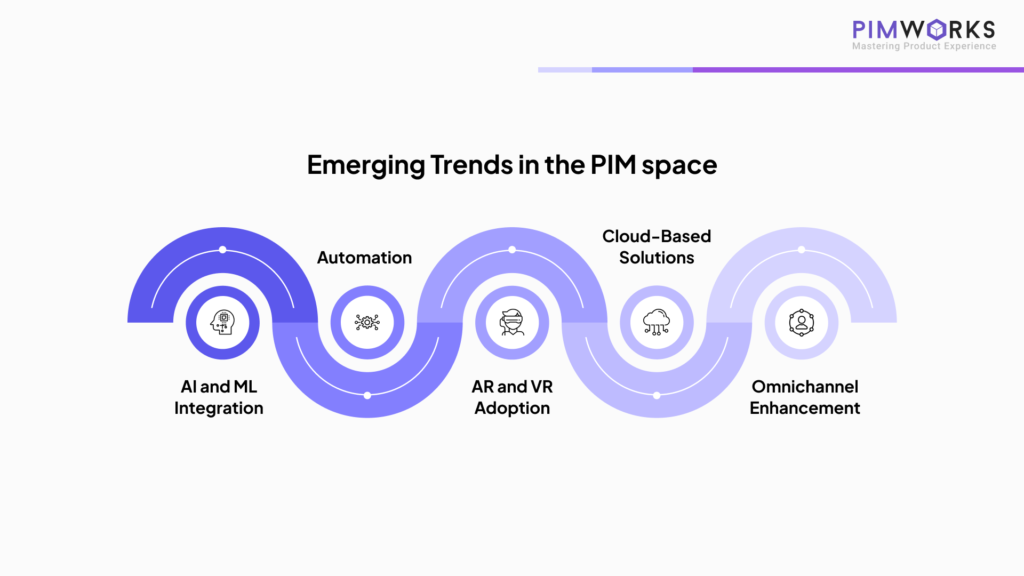
The emerging trends in Product Information Management are significantly reshaping the way businesses
approach e-commerce.
According to the study made by the Fortune Business Insights the overall product information management
market is projected to grow from $4.47 billion in 2024 to $20.66 billion by 2032. The estimated
growth rate (CAGR) is 21.1% during the period.
We are getting to see an expanding demand for online shopping. Hence, there is an unavoidable need to
consistently maintain accurate and up-to-date product information which drives the development of PIM
software.
As the product data is growing continuously in terms of volume and complexity, the integration of AI
and ML algorithms has become essential. This enables the automation of several complex and time
consuming tasks in a fraction of a second. Incorporating emerging technologies like Augmented Reality
(AR) and Virtual Reality (VR) will offer immersive product experiences.
Cloud-based PIM solutions are gaining significant popularity as it enables to collaborate and access
the data from anywhere while also reducing operating costs. PIM will further enhance its omnichannel
capabilities, ensuring seamless data distribution across the touchpoints.
Final Thoughts
Choosing the best PIM software goes beyond making a mere decision – it’s a big step towards unlocking the full potential of your business. With so many options and features out there, it’s easy to feel overwhelmed. That’s totally normal!
As we’ve explored, each PIM software comes with its own advantages and drawbacks. This implies that the one-size-fits-all approach won’t work here. You should align your decision with the exact needs and requirements of your business. And, don’t get fascinated by the fancy features, focus only on what really matters!
The right PIM will not only organize your product data but also streamline your operations, improve customer experience, and help you scale faster. On the flip side, the wrong choice can slow you down and hold your growth back (also with wasted time and efforts).
So, do your research (even if it takes a little more time!) and carefully find the right key for your business— the PIM software that opens up all the doors for your success. Your treasure awaits!
Let’s begin your Journey to better product management together!
FAQs
What
is PIM software used for?
PIM (Product Information Management) is a system that
helps businesses to centralize, manage, and distribute product information efficiently across all
the channels.
How
much does a PIM software cost?
PIM software can cost anywhere from $699/month to $25,000/year. PIM pricing
usually depends on your number of SKUs and how many marketplaces you sell on.
How
to choose a PIM?
Start by identifying your business needs—like how many products you
manage, which channels you sell on, and what tools you need to integrate with. Then compare PIMs
based on ease of use, support, features, and Pricing.
What
features should I look for in a PIM?
Look for features like Digital Asset Management (DAM), AI-powered content
enrichment, bulk import/export, predefined integrations, user access control, workflow management,
channel-specific personalization, and digital shelf intelligence.
What
are the benefits of a PIM?
PIM software improves data accuracy, streamlines content updates,
accelerates time-to-market, reduces manual errors, and enhances customer experience across all sales
channels.